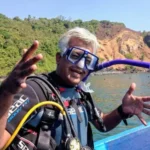
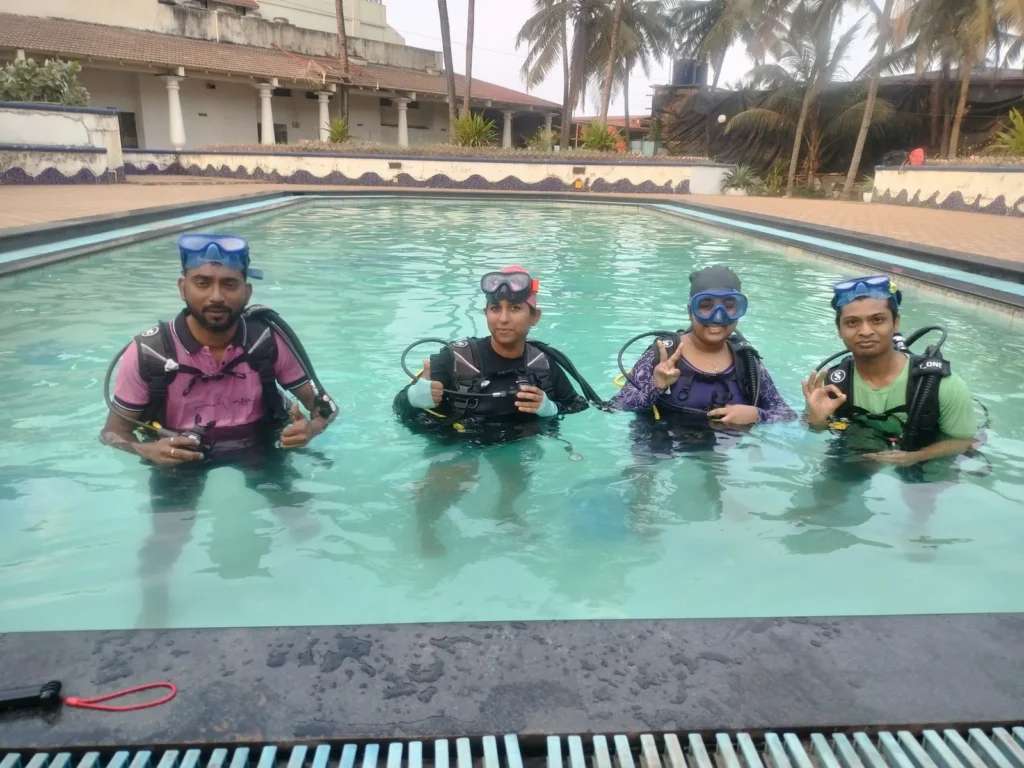
Yes. Scuba diving in Goa for non-swimmers works on a guided first dive with no swim test: SDI Scuba Discovery, 20 or 40 minutes. SDI (Scuba Diving International) is a worldwide training agency, founded in 1998. You practise in a pool first, then dive up to 9 metres at Grande Island with an instructor beside you, one to one. Only a certification course has a swim test.
Most mornings at the Novotel pool, someone takes me aside before the briefing and tells me, a little quietly, that they cannot swim. They expect to be sent home. Nobody is sent home for that, and this post explains why.
I came to diving late myself. I did my Open Water course at 44, and I still remember how odd those first breaths underwater felt. So I will not pretend the nerves are silly. I will tell you what actually happens, and where the real limits are.
Can non-swimmers do scuba diving?
Yes, on a try dive, because scuba diving and swimming use different skills.
Swimming is about keeping your head above water and moving through it with your arms and legs. On a dive you do neither. You breathe through a regulator, the mouthpiece connected to the tank, so your face is meant to be underwater. A BCD (buoyancy control device), the jacket that holds the tank, is filled with air at the surface and keeps you floating. Underwater, your instructor adjusts the air in it so you neither sink nor rise. Fins do the moving, with slow kicks. There are no strokes and no breath-holding.
On a first dive you are not even in charge of the depth or the direction. Your instructor holds on to you, controls the descent and steers. Your job is to breathe slowly and equalise your ears.
Here is the rule on swimming. No swim test, and you don’t need to be a strong swimmer. SDI asks that you’re comfortable in water, and your instructor checks this in the pool before the sea.
None of SDI, SSI or PADI sets a swim test (a distance you must swim) for a try dive. SDI’s standard asks for “comfort and adequate swimming skills”. PADI, for example, lists no prerequisites for Discover Scuba Diving, though its own FAQ adds that you should be comfortable in the water and able to stay at the surface. Your inflated BCD and your instructor take care of staying at the surface. Being calm with your face in the water is what the pool session is for. If water on your face makes you panic, we would rather find that out in a pool where you can stand than at 9 metres.
Does scuba diving require swimming?
Swimming is tested only when you train for a diving licence. A try dive has no swim test, and on a snorkelling trip a life jacket keeps you afloat.
| What you book | Swimming | Depth | Price per person |
|---|---|---|---|
| SDI Scuba Discovery 20 Min (Scuba 20) | No swim test | Up to 9 m | ₹2,970 + GST |
| SDI Scuba Discovery 40 Min (Scuba 40) | No swim test | Up to 9 m | ₹4,950 + GST |
| SDI Scuba Discovery 20+20 | No swim test | Up to 9 m | ₹6,930 + GST |
| Snorkelling, life jacket given | Not needed | Surface | ₹1,980 + GST |
| SSI Scuba Diver course | Be comfortable in water | Up to 12 m | ₹17,820 + GST |
| SSI Open Water Diver course | Swim and float check | Up to 18 m | ₹23,760 + GST |
On every first dive an instructor stays with you one to one. Prices are from our scuba diving price list for Goa, checked on 5 November 2026.
Why the difference? On a try dive, a professional is with you every second and you never go below 9 metres. A certified Open Water diver dives with a buddy, without an instructor, down to 18 metres. If something goes wrong at the surface, they have to look after themselves and their buddy.
So the course comes with a water skills check. PADI’s Open Water course, for example, asks you to float or tread water for 10 minutes without aids, and to swim 200 metres without stopping (or 300 metres with mask, fins and snorkel). There is no time limit. SSI’s Open Water course has its own water fitness evaluation, done before the open water dives. Nobody times you; the instructor wants to see that you are at ease in water.
How a non-swimmer’s first dive works in Goa
Here is the morning, roughly as it runs. Times move by about 15 minutes depending on the group and the sea.
Forms and the medical statement (about 6 am)
You arrive at Novotel Resort & Spa in Candolim, fill in the forms and meet your instructor. One of those forms is the medical statement, a standard diving questionnaire about your heart, lungs, ears and any medication. If you answer yes to a question, a doctor has to clear you before you dive. Fill it in honestly. It protects you more than any piece of equipment does.
Non-swimmers sometimes stop at one line. The widely used Diver Medical Participant Questionnaire asks whether you have had difficulty with moderate exercise, and gives swimming 200 metres without resting as one example. It is a fitness question, not a swim test; walking 1.6 km in 14 minutes is the other example on the form. If you are unsure how to answer anything, ask us before you sign.
In the pool at Novotel (about 6:30 am, one hour)
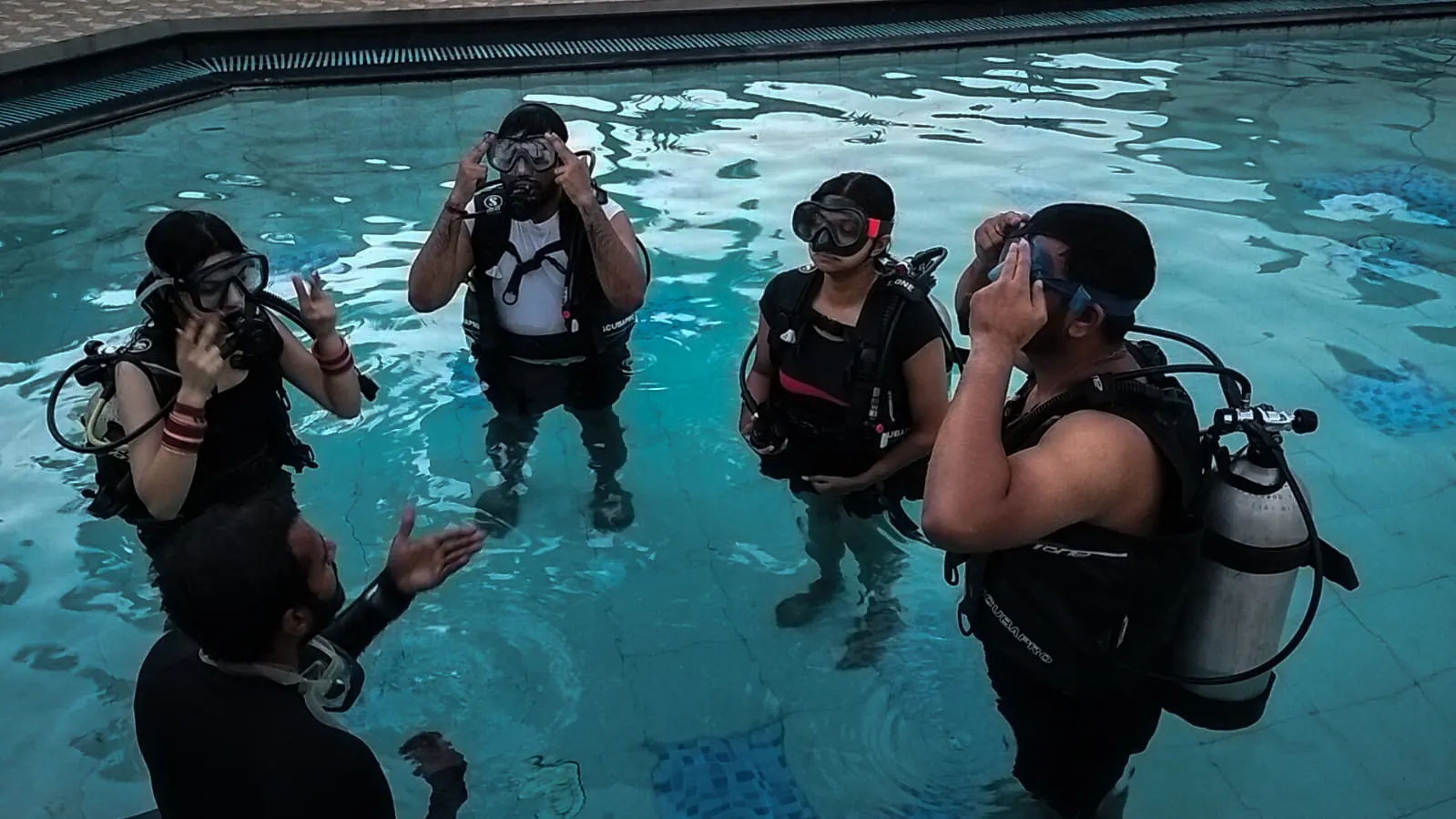
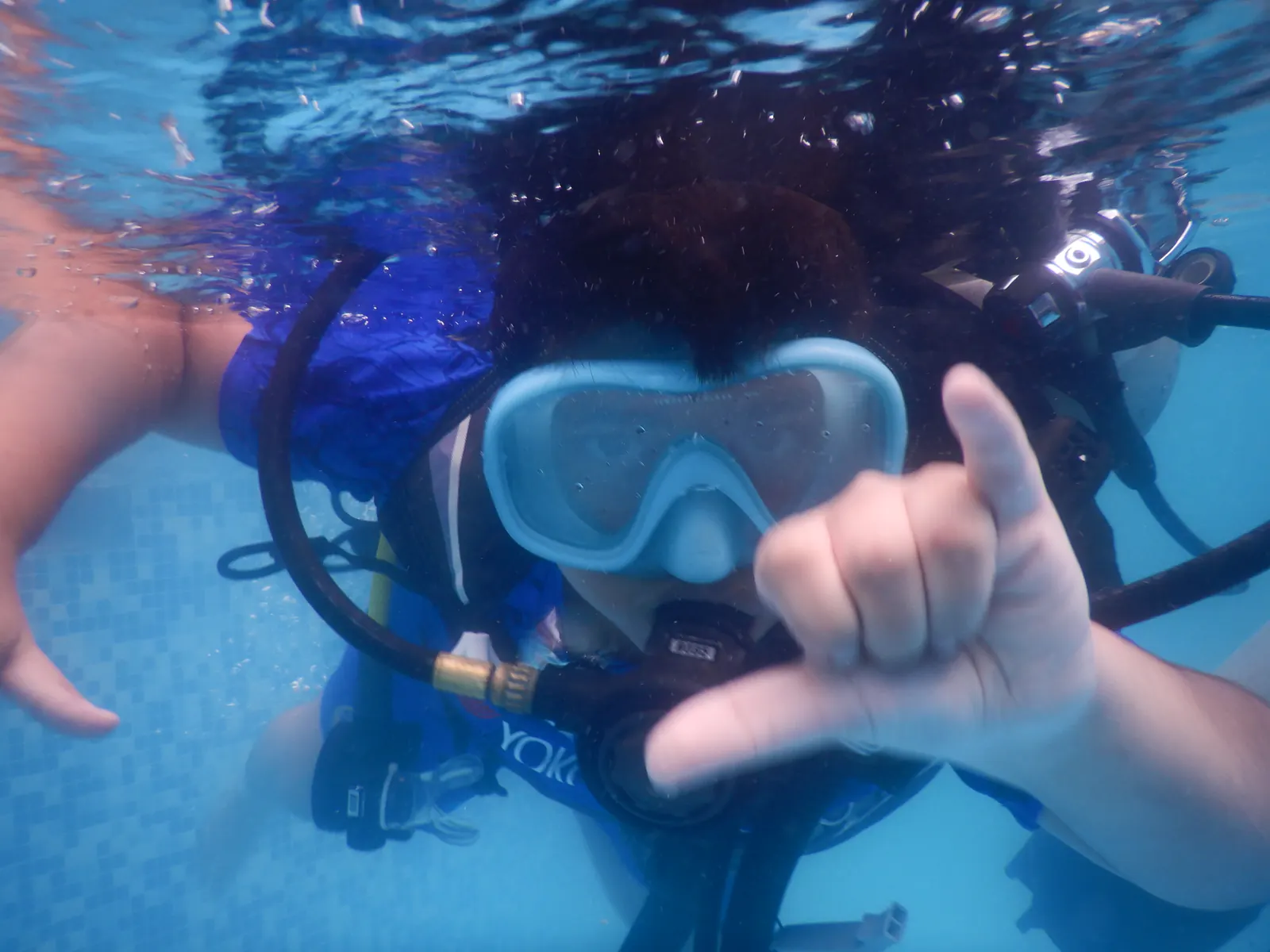
Your first breaths underwater happen in a hotel pool, in water where you can stand up. SDI asks for at least 30 minutes of pool practice before the sea, and ours runs about an hour. The instructor shows you how to breathe through the regulator, clear water out of your mask, equalise your ears and use the hand signals for OK, problem and up. Then you kneel, put your face in and breathe.
For most people that is where the fear starts to go. If it takes longer, it takes longer. We do not go to the boat until you are comfortable.
On the boat to Grande Island (about 8:30 am)
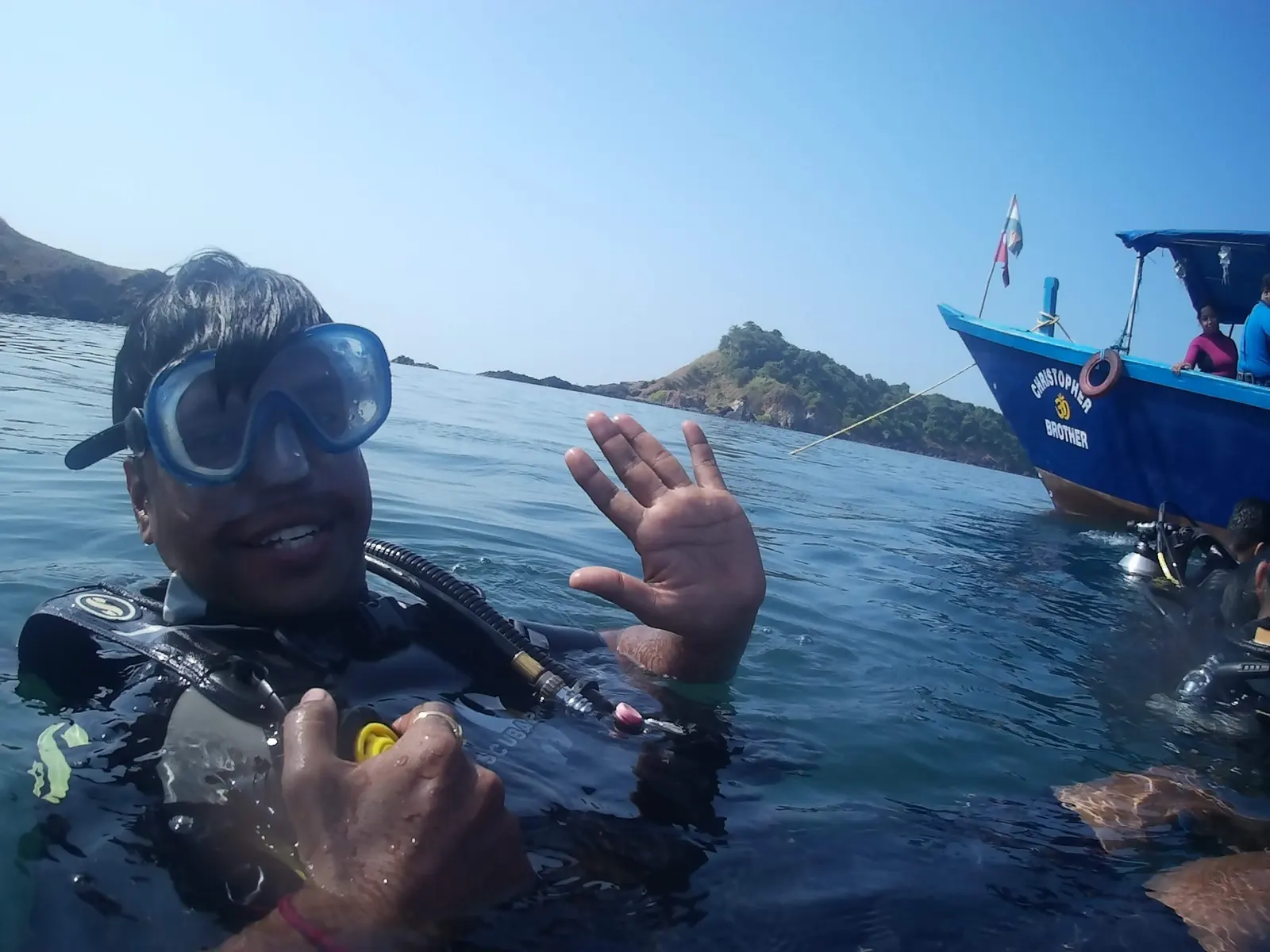
After tea at the hotel, the boat takes you to Grande Island, about 30 minutes away. Dolphins often show up on the way, though nobody can promise them. Before you get in, your instructor goes through the signals again and inflates your BCD, so you float from the moment you touch the water.
Under the water (20 or 40 minutes)
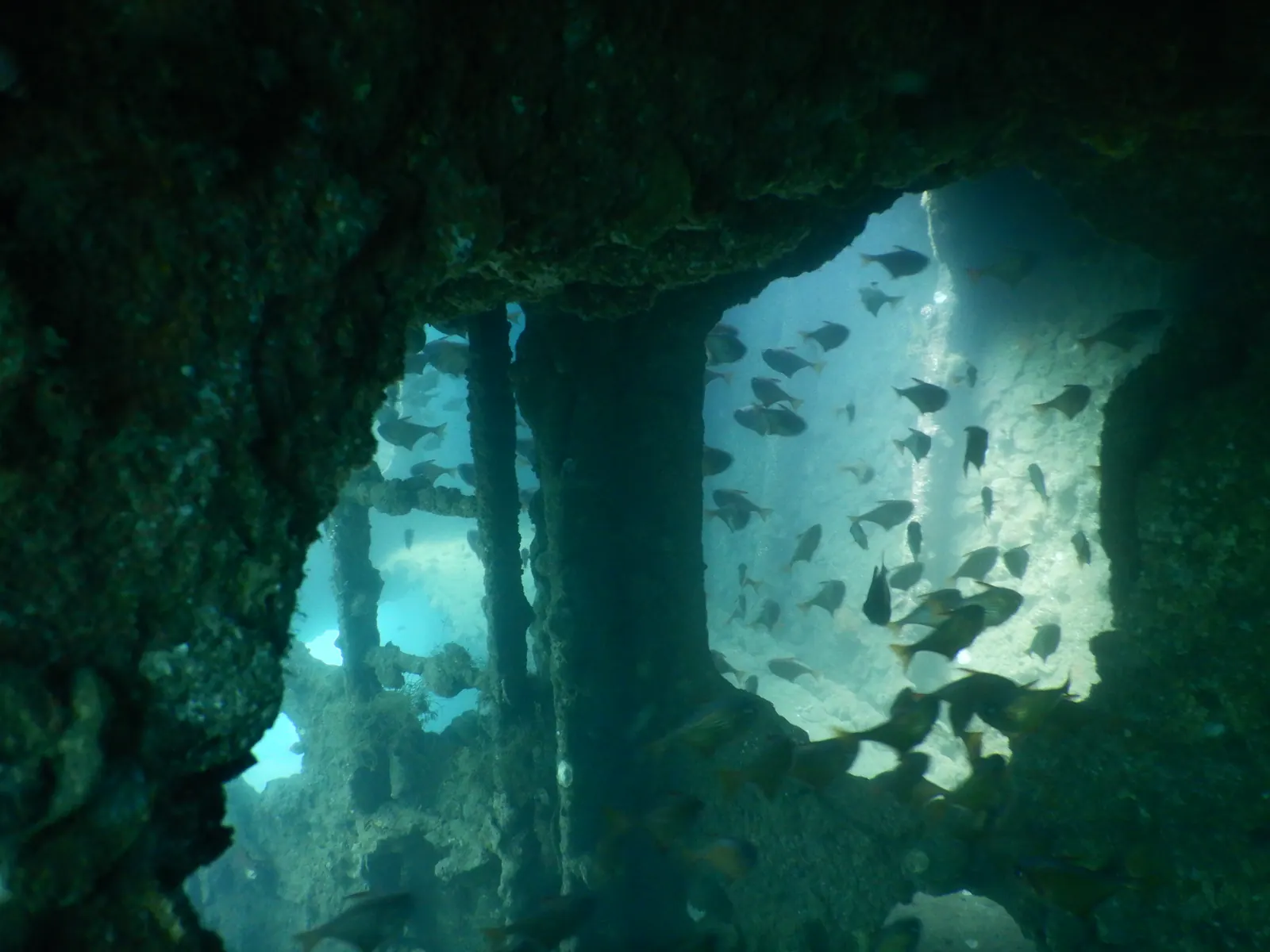
You go down slowly, holding the instructor or the descent line, and stop every metre or so to equalise. The instructor keeps a hand on your BCD and decides the depth, never more than 9 metres (30 feet), which is SDI’s limit for this dive. At that depth you see the reef and shoals of snappers and butterflyfish, and the 40-minute dive usually includes the British-era wreck. Our marine life in Goa page lists what we actually see there.
HD photos and video are included too, taken by our underwater photographer, so your instructor’s hands stay free for you. On a half-day dive, the link usually reaches you within three hours of getting back.
Is scuba diving safe for non-swimmers?
Yes, when the dive is run properly, because the risks on a first dive have little to do with swimming.
Research on beginners points the same way. A study of 42 scuba students by Morgan, Raglin and O’Connor (2004) starts from something instructors already know: a rapid, uncontrolled rise to the surface usually begins with panic. It then found that the students who were more anxious at the start were the ones more likely to panic during training. So most of the safety work is about keeping you calm and in control, and most of that is preparation:
- a pool session before any sea dive
- one instructor per diver on every SDI Scuba Discovery dive
- a depth limit of 9 metres on first dives, with the instructor controlling the descent
- the medical statement, and a doctor’s clearance where it is needed
- if the sea is unsafe on the day, we reschedule your dive or refund you in full
- ₹10 lakh insurance on every first dive, and ScubaPro gear serviced on schedule
Here is the honest part. Some people should not dive on a given day, swimmer or not. A blocked nose or a cold will stop you equalising. Pregnancy, recent surgery and some heart, lung and seizure conditions are on the medical statement for good reason, and a doctor decides on those, not us and not you. And do not book a flight on your dive day: wait at least 18 hours after one dive and 24 hours after two.
Is scuba diving scary for non-swimmers?
It can feel strange for the first few minutes. Then, for most people, curiosity takes over. There is a lot to look at down there.
The hard moments are usually the same: the first breath through your mouth with your face in the water, a little water seeping into the mask, and stepping off the boat into open sea. Each is practised in the pool first, and mask clearing is repeated until it is boring.
Underwater, you can hold your instructor’s hand for the whole dive if you want to, and you can signal to go up at any time. The instructor can slow down or end the dive early. Nobody on the boat will think less of you for it.
On the boat, the most nervous guest is usually the quiet one, not the one asking questions. If that is you, tell your instructor. Saying it out loud helps them help you. If you already know you are very nervous, book SDI Scuba Discovery 20+20: two short dives with a rest on the boat in between. The first dive takes the edge off, and on the second you actually look around.
There is more on this in our post on what fears scuba divers actually face.
Which first dive should a non-swimmer choose?
Choose by how much time you want underwater, not by how well you swim. All four first dives are SDI Scuba Discovery dives, and all four are open to non-swimmers.
- Scuba 20 (₹2,970 + GST), if you simply want to know what breathing underwater feels like.
- Scuba 20+20 (₹6,930 + GST), if you are nervous: two short dives, wreck and reef, with a rest between them.
- Scuba 40 (₹4,950 + GST), the one most people book. Forty minutes gives you the reef and usually the wreck, and your dive is registered with SDI.
- Scuba 40+40 (₹8,910 + GST), two long dives and a full day at sea.
On the 20+20 and 40+40, your first dive is your SDI Scuba Discovery dive. After it, you can keep diving under your instructor’s direct supervision, so the second dive is with your instructor right beside you. Both dives stay within 9 metres.
If you are unsure, I would pick Scuba 40. Twenty minutes often ends just as people relax. You can compare all four on the first-time divers page, or put your own day together on build your own dive.
If someone in your family does not want to dive at all, they can come on the same boat and snorkel at Grande Island. Non-swimmers get a life jacket, and snorkelling in Goa with us costs ₹1,980 + GST. It is self-guided, so they should stay close to the boat.

What to ask before you book a non-swimmer dive in Goa
Ask five questions, whoever you book with:
- Is there a pool session before the sea?
- Will an instructor stay with me, one to one, for the whole dive?
- How long will I be underwater, and how deep?
- Will I fill in a medical statement?
- Is the instructor certified with a recognised agency such as SDI, PADI or SSI, and am I insured?
Some cheap packages give you 10 to 15 minutes in shallow water, with one guide for several people. That may suit you, but you should know it before you pay. If the answers to these questions are vague, that tells you something too.
Also check what you are actually buying. Some Goa packages sell a sea walk next to scuba. On a sea walk you wear a helmet fed with air from the boat and walk on the sea floor. It has no swim test either, but it is a different activity, and it is not scuba.
Plan your dive: Can’t swim and want to try? Our first-time scuba dive in Goa starts at ₹2,970 + GST, with pool practice first and an SDI-certified instructor beside you the whole time.
Should you learn to swim later?
Only if you want a diving licence. A try dive has no swim test.
If the first dive makes you want more, get comfortable in water before the course: swim a few lengths without stopping and learn to float on your back. Then the SSI Open Water Diver course takes 3 to 4 days and costs ₹23,760 + GST (the PADI version is ₹35,472 + GST). It certifies you to dive to 18 metres anywhere in the world, with a buddy instead of an instructor.
Questions people ask us
Can non-swimmers do scuba diving in Andaman?
Yes, non-swimmers can do a try dive in the Andaman Islands too. Dive centres there run the same kind of first dive, with an instructor holding on to you, and courses there need the same swim and float check. What changes from place to place is the operator, so ask the same five questions before you book.
Is snorkelling safe for non-swimmers?
It is, if you wear a life jacket and stay close to the boat. On our Grande Island trip, non-swimmers get a life jacket. The snorkelling is self-guided, so keep the boat within easy reach and come out if the water gets choppy.
Is scuba diving in Goa worth it?
For a first dive, yes, as long as you go with honest expectations. Goa is not the Maldives: visibility at Grande Island is 2 to 15 metres depending on the day, and the water is 27 to 30°C. What you get is warm, sheltered water, reef fish, a wreck, and a pool session before any of it. Our scuba diving in Goa page has the season and the dive sites.
What is the minimum age for a try dive?
The minimum age is 10, and anyone under 18 needs a parent’s consent. If your child is 8 or 9, ask us about SDI Future Buddies, our pool-only programme for kids aged 8–12.
Can I dive if I wear glasses?
You can. We have masks with prescription lenses. Mention it when you book.
The one thing to remember
The equipment and your instructor do the work that swimming would do. Your part is to breathe slowly and to be honest about how you feel, on the medical form and in the water.
If you would like to try, start with a first dive in Goa from ₹2,970 + GST. Hope to take you diving.